

Quality over quantity in hiring means one thing: stop drowning in the wrong applications and start connecting with the right people. As unemployment rises and job vacancies decline in the UK (according to ONS), the best talent teams are shifting from high-volume application funnels to strategic friction, using rigorous intake meetings, inline assessments, and data-driven channel management to attract the right candidates and filter out the wrong ones early.
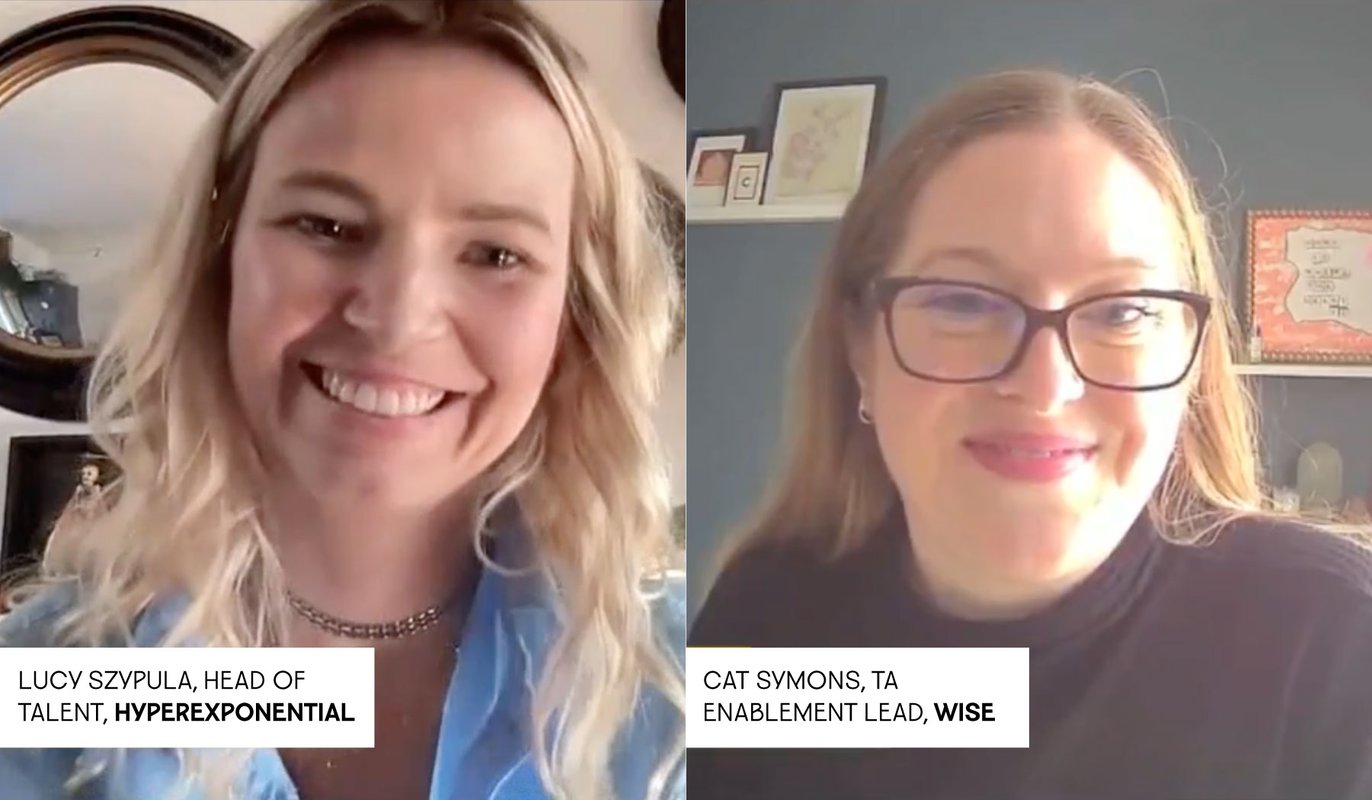
We recently sat down with Cat Symons, Global Talent Acquisition Enablement Lead at Wise, and Lucy Szypula, Head of Talent at Hyperexponential, to hear how they’re tackling these challenges; and get their take on the practical steps talent leaders can take to find their people.
Here are five key takeaways from our conversation.
Start with the intake meeting
A well-structured intake meeting allows recruiters to truly understand what hiring managers need, but most intake meetings fail because they focus on what the role is rather than why it exists and who will succeed in it.
Quality starts here. If the intake meeting is vague, every downstream decision, from sourcing channels to interview questions, will be misaligned.
Lucy emphasised the importance of being critical during this stage, saying, “Noise can come from outside. But you can also create a lot of noise internally if you’re not really keeping your hiring teams accountable ensuring they have everything they need to confidently make those decisions, and look for the things you care about in candidates.”
“For us, it’s always optimising for signal. This also means that we invest a lot of time in ensuring early internal alignment because there is no worse thing than having thousands of applications, but on top of that, you don't have a completed intake meeting or your hiring team isn't aligned on what they're actually looking for.”
What does a rigorous intake meeting actually cover?
The best ones go beyond a list of skills and dig into context:
-
What does success look like in the first 90 days? This forces hiring managers to articulate outcomes, not just activities.
-
What are the must-haves versus nice-to-haves? Many job specs conflate the two. A disciplined intake meeting separates them ruthlessly.
-
What's the context this person will be stepping into? Is the team growing or stabilising? Is this a backfill or a new remit? How much autonomy will they have?
-
Who has succeeded (or struggled) in similar roles here? This surfaces unspoken cultural or team dynamics that a CV can't predict.
If your intake meetings feel like box-ticking exercises, you're optimising for speed, not signal. Slow down here to speed up everywhere else. A 45-minute intake meeting with key hiring stakeholders can save you from reviewing 200 irrelevant applications before, potentially, starting over with your search.
Use strategic friction as a filter for quality candidates
It’s tempting to make the application process as easy as possible, but sometimes a little “friction” can be a powerful filter.
Good friction refers to intentional barriers in the application process that deter low-effort or misaligned candidates without discouraging strong ones. Examples include inline assessments, role-specific questions, or brief skills demonstrations that mirror the actual job. Unlike bad friction (generic, lengthy forms), good friction self-selects for motivation and fit.
The key word is strategic. Badly designed friction (long, generic application forms or multi-stage assessments that don't mirror the actual job) will screen out great candidates. Good friction, on the other hand, self-selects for motivation and fit.
At Hyperexponential, the team adds carefully chosen application questions to help candidates self-select in and out of applying. Job descriptions include sections like “You’re unlikely to thrive here if…”, designed to be bold and upfront about culture and expectations.
Lucy’s advice: “We believe it’s our job to equip everyone to make their decision. If candidates are finding this off-putting, they are unlikely to thrive here anyway. So we’re seeing it as a win-win situation for sure [being clear and up-front in their job descriptions].”
Using inline assessments at the top of the funnel
Instead of carefully evaluating whether they're a good fit before even applying to a role, candidates are increasingly applying broadly and letting TAs do the filtering. They've shifted the burden of qualification, skills, and experience assessment from themselves to already stretched talent teams.
At Wise, the team puts technical tests and skills assessments at the very start of the process; not after initial CV screens. This creates what Cat calls “good friction.” Candidates who are motivated and genuinely interested will complete the assessment; those who aren’t will move on.
“We see it [technical tests] as good friction. If somebody wants to work for Wise and this is part of their application, we would assume that they would complete the test to do it,” she says.
Lucy explained how Hyperexponential applies this principle in practice, saying, "At Hyperexponential, we use inline assessments on our application forms. It's a simple way to filter out people who aren't serious about the role.
The impact? Higher conversion rates from application to first interview, and a much clearer sense of who’s really invested in the opportunity. This can mean a huge time saving, especially during hiring sprints. Cat admits, "At Wise, we've always been focused on making sure our processes are repeatable and scalable, so we're not compromising on quality even when we're hiring at speed."
What does "good friction" look like in practice?
Both Wise and Hyperexponential include short, role-specific questions directly in their application forms. For a product role, that might be: "Describe a time you had to prioritise competing stakeholder needs. What framework did you use?" For an engineering role: "What's the most complex technical problem you've solved in the last year?"
These questions are designed to:
-
Surface thinking, not just credentials. A candidate's approach to a problem often tells you more than their CV.
-
Respect serious candidates' time. A 3-minute inline question is faster than a generic cover letter and more useful to reviewers.
-
Filter for motivation and values alignment. Candidates who aren't genuinely interested won't complete thoughtful answers, and that's the point.
When designed thoughtfully, these questions can improve both hiring quality and candidate experience. Serious candidates appreciate this clarity and relevance. Friction isn't about making applications harder. It's about making them more relevant. If your application form feels like a CV upload and a "Why do you want to work here?" box, you're not filtering for signal. You're just collecting more noise.
Be ruthless with data-driven channel management
Not all sourcing channels are created equal. Some deliver high volumes of applications but low conversion rates. Others bring fewer candidates, but a higher percentage progress to offer.
According to LinkedIn's 2024 Global Talent Trends report, companies that track candidate source quality see a 30% improvement in new hire retention compared to those that focus solely on volume metrics.
Both Cat and Lucy stressed the importance of analysing which channels consistently deliver quality candidates.
Both Wise and Hyperexponential regularly analyse not just application volume, but conversion rates and quality of hire by source. If a channel consistently brings in low-quality candidates, it gets cut (regardless of volume).
Lucy points out, “What we see when we screen candidates through Welcome to the Jungle is that they come to all of the screenings and all of even the initial interactions much, much warmer and with a better understanding of what Hyperexponential does and what our mission is. That already is a massive time saver for us because we can then dive deeper into what we actually need to test for and look for that signal rather than just spend our time selling.”
Cat adds, “We continue to make sure that our adverts are attracting diverse candidates and this is where I personally find Welcome to the Jungle really adds value to our hiring because of the data we can also pull from the platform and working with our customer success manager there.”
The bottom line: track your sourcing data ruthlessly. If you're not tracking conversion rates by source, you're flying blind. Even simple data (like how many candidates from each channel make it to second interview) can reshape your sourcing strategy. On Welcome to the Jungle, talent teams can see the performance of sourcing and applications separately, and can get a sense of who is coming in and falling out of the funnel by gender, ethnicity, experience level and more. All from a clear analytics dashboard, without guessing or complicated reports.
Use AI thoughtfully (to support humans)
Both Wise and Hyperexponential are harnessing AI to handle admin tasks.
Cat says, “We use AI note takers in all of our screening calls, kickoff meetings, and debrief meetings of hiring teams.” This frees up recruiters to do what they do best: connect, assess, and create a thoughtful candidate experience.
And Lucy admits, “We are 100% maximalist when it comes to process optimisation and looking for ways in which AI can help us do even more of what we actually love.” AI is still seen as a tool to remove admin burden and streamline candidate experience, not to replace judgment or empathy. Both organisations believe it’s important to keep humans in charge of actual hiring decisions.
Our view: AI works best when it augments human judgment, not replaces it. Use it to surface patterns or streamline admin, but keep human oversight in the parts of the process where context and culture matter most.
Build authentic employer brand content
Strong employer branding helps you attract the right candidates in the first place, reducing the need to filter out the wrong ones later.
Candidates are more discerning than ever, and glossy employer brand content alone won’t cut it. Both Cat and Lucy emphasised the value of being upfront about both the positives and the challenges of working at their organisations.
Lucy shared how Hyperexponential invests in making their EVP clear and consistent across all touchpoints: "At Hyperexponential, we make sure candidates understand what we're about before they apply. That way, we're already pre-filtering for people who resonate with our mission and culture."
Employer branding isn't just marketing. It's a recruitment efficiency tool. If candidates self-select based on a clear EVP and assessment of your culture, you spend less time screening out mismatches. You find your people faster. A great way to do this authentically is with videos that help showcase what your people are like (in their own words), what the office environment is like, and bring to life what words, alone, can’t.
What this all means for you
The shift from volume to quality isn't only about reducing workload. It's about building a more effective, sustainable hiring process. By starting with rigorous intake meetings, using strategic friction, and tracking your channels you can spend less time sifting through applications and more time engaging with candidates who truly fit.
Watch our full conversation with Cat from Wise and Lucy from Hyperexponential on demand.

.webp?width=400&height=250&name=top%20(1).webp)